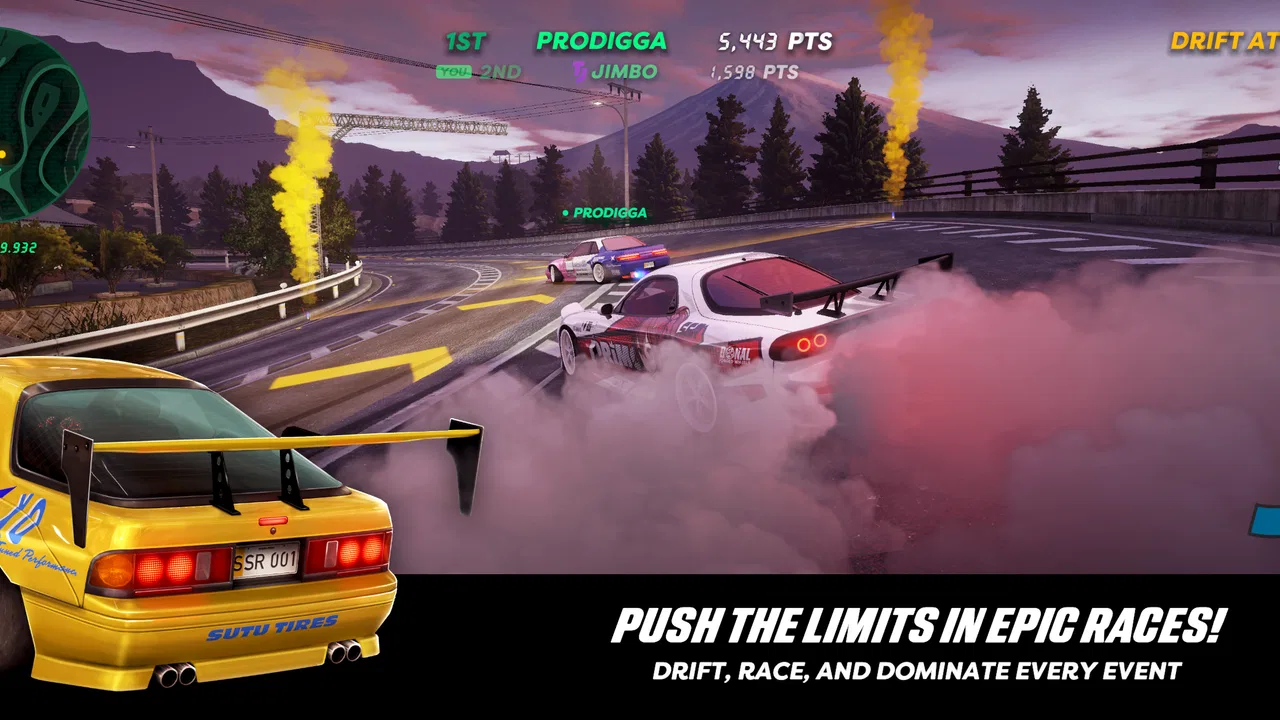
Static Shift Racing
- 4.5
- Rating
- 10.00M
- Installs
- Free
- Price

 Analysis by App-foxy
I spent time with Static Shift Racing as a mobile racing game, and my first impression was that it aims for a very specific kind of fun: quick underground street-racing sessions where the satisfaction comes from improving your car, learning a route, and beating human competition rather than simply completing a quiet solo time trial. It is free to download, carries a Teen content rating, and comes from Timbo Jimbo. That combination makes it easy to try, but the real question is whether its racing loop gives you enough reason to keep returning.
My answer is mostly yes, especially if you enjoy arcade-style driving and like the idea of competing against real rivals. It is not the best fit for somebody looking for a serious simulator, a calm driving game, or a completely frictionless free experience. The appeal is more immediate: start a race, make quick decisions, recover from mistakes, and gradually become more comfortable with the streets and the cars.
How the racing experience works in everyday play
The strongest way to approach this game is in short, focused sessions. I found it easier to enjoy when I treated each race as a small challenge rather than expecting a full console-style campaign every time I opened it. A few minutes can be enough to test a route, try a different approach to a corner, or see whether a rival’s pace is beatable. That makes it suitable for a commute, a break, or a quick evening session when I do not want a long commitment.
You May Also Like

 Blood Strike: 2.5 Anniversary
Blood Strike’s Loadouts Turn Every Drop Into a Tactical Gamble
A close look at Blood Strike’s custom loadouts: how fast access to signature weapons reshapes its battle royale rhythm, rewards preparation, and narrows the gap between fights.

 Pandora - Music & Podcasts
Pandora’s Music Is Easy to Start, but Harder to Recover
Pandora’s strength is its low-effort path from a seed to a station. Its weak spot is how much confidence it asks you to place in connection, setup, and quiet recovery.

 8 Ball Pool
 Is Built on Rivalries, Rematches, and Routine
A close look at the rivalries, rematches, shared routines, and unanswered safety questions that turn a quick pool match into a persistent mobile community.

 Samsung Music
’s Quiet Strength Is Playing What You Already Own
Its reach comes less from spectacle than from dependable access to a personal library. That simplicity is both the app’s strongest retention engine and its ceiling.

 AccuWeather: Weather Radar
AccuWeather Review: A Quick, Clear Forecast for Everyday Decisions
For everyday plans, the best forecast is the one you can understand quickly. AccuWeather makes rain timing, radar, and local conditions easy to act on, with a few trade-offs.

 Hill Climb Racing
Why Hill Climb Racing Still Turns Crashes Into One More Run
A tiny car, a bumpy hill and one more upgrade: Hill Climb Racing keeps resurfacing because its simple chaos makes every near-miss feel personal.
More From Our News Desk



The underground setting gives the racing a clear identity. Instead of presenting itself as a formal motorsport package, it leans into the fantasy of building a reputation on the street. That tone matters because it changes what I look for during a race. I am not only watching the finish position; I am paying attention to how confidently I can carry speed, whether I can avoid losing momentum, and whether a risky move is worth attempting.
Arcade racing is at its best when the controls feel understandable within the first few attempts but still leave room for improvement. That is the balance I looked for here. A newcomer should be able to begin without studying a manual, while a more experienced player can still find value in repeating a course and refining decisions. If you prefer racing games where every mistake is heavily punished by realistic handling, this will probably feel too forgiving or too game-like. If you want accessible action, that is a strength.
A realistic everyday scenario is playing one or two races while waiting for an appointment. I would use that time to focus on one practical goal, such as learning where I usually lose speed or deciding whether a different car setup suits my driving better. That approach is more useful than mindlessly replaying races, because short sessions become a gradual learning routine instead of a sequence of disconnected attempts.
What makes the competition matter
The presence of real rivals gives the game more tension than a purely offline race against predictable opponents. Even when a session is brief, another driver’s pace can make a familiar route feel different. I like that this creates a reason to improve beyond simply unlocking the next piece of content. You are trying to prove that your choices and reactions are good enough against somebody else’s result.
That competitive focus also creates one of the game’s main trade-offs. Players who enjoy racing only at their own pace may find the pressure irritating, particularly after a mistake late in a run. The game is more rewarding when you accept that some attempts will be about learning rather than winning. I recommend treating a lost race as information: notice where the gap opened, then change one decision on the next attempt instead of changing everything at once.
That small habit is one of the most useful ways to get better. If I alter the car, route choice, and driving style simultaneously, I cannot tell what helped. Keeping one variable stable makes progress easier to recognize and prevents the upgrade system from becoming a guessing game.
Free access and the purchase question
The game is free, so there is no purchase barrier before you can decide whether its driving feels right for you. That is important for a racing title because handling preference is personal. A trailer or store description cannot tell you whether the controls suit your hands, whether the race rhythm keeps your attention, or whether the competitive structure feels motivating rather than stressful.
Optional in-app purchases range from $1.24 to $79.99 per item. I would interpret that range carefully: free entry gives the game its initial value, but the value of spending depends on how much you play and how comfortable you are with the progression. I would not recommend paying simply because a race has gone badly. First establish that you enjoy the core driving loop, then decide whether an optional purchase genuinely improves your experience.
This is also where expectations matter. A free racing game can be excellent value even if you never spend, provided you are happy to work through its progression at the free pace. On the other hand, someone who dislikes waiting, repeating races, or feeling tempted by optional purchases may prefer a paid racing game with a clearer one-time cost. I cannot call either model universally better; the right choice depends on whether you value immediate access or predictable spending more.
For families, the Teen rating is worth noticing before installation. I would not treat it as a children’s racing game by default. Parents should check whether the competitive atmosphere, street-racing presentation, and purchase options fit the player’s age and household rules. The game is available for devices running Android 9 or later, which is useful to check before trying it on an older phone or tablet.
Where the value comes from
The best value is not just the number of races you can start. It comes from the combination of accessibility and repeatability. A route can be familiar but still worth revisiting when you are chasing a better result, testing your control, or comparing how a change affects your driving. That gives the game more staying power than a collection of one-time challenges.
I also appreciate that the game can serve two different moods. When I want something casual, I can focus on getting through a race cleanly. When I want a stronger challenge, I can treat the same session as a test of consistency. That flexibility is valuable on mobile, where the amount of attention I have available changes from one launch to the next.
One non-obvious advantage is that short sessions can reveal weaknesses in your driving more clearly than long play sessions. If I only have time for a few attempts, I notice recurring errors: braking too late, taking a corner with the wrong line, or becoming impatient after falling behind. Those patterns are easier to correct when I isolate them. The game works well as a compact practice tool for arcade racing habits, not just as a way to fill time.
Another useful approach is to separate experimentation from competition. I would use one run to try a different route or driving decision without worrying about the result, then use the next run to apply what I learned. This prevents every race from feeling like a final exam. It also helps players who become frustrated by rivals, because improvement becomes the immediate objective even when victory is not.
Limitations I noticed while judging it fairly
The competitive design can be demanding in a way that is not always relaxing. A player who wants a gentle game for switching off may find the focus on rivals too intense. Racing naturally creates winners and losers, and repeated losses can make the progression feel slower than expected. I would skip this game if I already know that leaderboard-style pressure makes me stop playing rather than improve.
The free-to-play structure is another possible source of friction. Even though the initial cost is zero, the existence of optional purchases means I would approach progression with a clear personal rule: play first, spend later, and only spend if the game has already earned that confidence. Players who prefer to pay once and remove all purchase decisions may be happier with a premium alternative.
There is also a difference between accessible racing and deep simulation. If you want detailed real-world vehicle behavior, careful mechanical tuning, or a driving experience built around authenticity, this is probably not the right destination. Its appeal is the immediacy of street racing and the satisfaction of beating a rival, not the patience required by a simulator.
Phone performance and screen size can affect comfort in any racing game, so I would pay attention to how clearly you can read the road and control the car on your device. A larger screen may make visual decisions easier, while a smaller one can make fast reactions feel more cramped. I would not judge the game solely by a single difficult session if the problem is that the controls feel crowded on your particular phone.
Who is most likely to enjoy it
Static Shift Racing is a good match for players who want free access to an arcade racing game with a street-focused identity and competitive motivation. It suits people who enjoy improving through repetition, prefer short sessions, and like having another driver’s performance as a target. It is also a sensible choice for someone who wants to test a racing game before committing money to the genre.
It may be especially appealing if you enjoy setting small goals. Instead of demanding a long uninterrupted session, you can decide to finish one cleaner race, improve one weak section, or become more consistent with a particular car. That structure makes the game easier to fit around ordinary life, and it gives a purpose to sessions that do not end in first place.
I would be more cautious if you want a fully offline-feeling experience, a strict simulation, or a single fixed price with no optional spending decisions. I would also suggest looking elsewhere if you dislike replaying routes or competing against other players’ performances. A more traditional premium racer may offer better value for that audience, even if it has a higher initial cost.
The game’s popularity suggests that its basic idea has reached a substantial audience: it has more than 10 million installs, an average rating of 4.6 from around 108 thousand ratings, and roughly 1.8 thousand written reviews. Those figures do not replace personal testing, but they do indicate that the core concept has connected with many mobile players. I would still use the free entry point to make my own decision, because racing controls are too subjective to judge from popularity alone.
Version, longevity, and the final decision
The current version is 117.1.0, and the game was released on January 17, 2023. For me, those details make it feel like an established title rather than a first experiment that has just appeared. The practical takeaway is to install it with the expectation of a developed racing experience, while still judging updates and progression by how well they serve your own play style.
My final verdict is positive but conditional. I would recommend trying it if you want a free, competitive street-racing game and you are willing to improve through repeated attempts. The strongest value comes from being able to enter without paying, learn the handling for yourself, and decide later whether optional purchases are worth considering. That is a better proposition than spending before discovering that the driving style is not for you.
I would skip it when your priority is realism, a relaxed solo experience, or a completely predictable one-time purchase. For everyone else, the sensible plan is simple: install it, play several short sessions without spending, and judge whether beating rivals feels rewarding enough to justify continued time. The free starting point is the game’s clearest advantage, while its competitive pressure and optional purchase structure are the trade-offs to understand before committing.
After that trial, the choice becomes personal rather than complicated. If you find yourself replaying a route because you genuinely want a cleaner, faster run, the game is delivering real value. If you are only replaying because progress feels locked behind frustration, a different racing game will probably serve you better. That distinction is the most honest way I can recommend it to a friend.
FAQs for Static Shift Racing
01What are the key features of Static Shift Racing?
Static Shift Racing offers a range of exciting features including customizable cars, diverse racing tracks, and competitive multiplayer modes. Players can enjoy real-time racing against others or explore single-player missions. The game boasts realistic graphics and dynamic weather effects, enhancing the overall racing experience.
02Is Static Shift Racing free to play, or does it have in-app purchases?
Static Shift Racing is free to download and play, but it includes in-app purchases. These purchases allow players to unlock premium cars, upgrade parts, or access special features. While the game can be enjoyed without spending money, some items might enhance the gameplay experience.
03What devices are compatible with Static Shift Racing?
Static Shift Racing is available for both Android and iOS devices. It requires Android version 5.0 or higher and iOS 11.0 or later. The game is optimized for both smartphones and tablets, ensuring a smooth gaming experience across different screen sizes.
04How can I improve my skills in Static Shift Racing?
Improving your skills in Static Shift Racing involves practicing different tracks and learning the nuances of each race. Experiment with car customization to find the best setups for speed and handling. Engaging with the community through forums and watching gameplay videos can also provide valuable tips and strategies.
05Are there any known issues or bugs in Static Shift Racing?
Like many apps, Static Shift Racing may have occasional bugs or issues. Users have reported minor glitches, such as graphic lags or connectivity problems in multiplayer mode. The developers actively work on updates to address these concerns, and players are encouraged to report any issues for quicker resolution.
Pros
- Stunning graphics with realistic car models.
- Smooth controls enhance driving experience.
- Wide variety of customizable cars.
- Engaging multiplayer mode.
- Regular updates with new tracks.
Cons
- Requires a stable internet connection.
- In-app purchases can be pricey.
- Occasional lag on older devices.
- Limited offline features.
- High battery consumption.

Static Shift Racing
Gallery